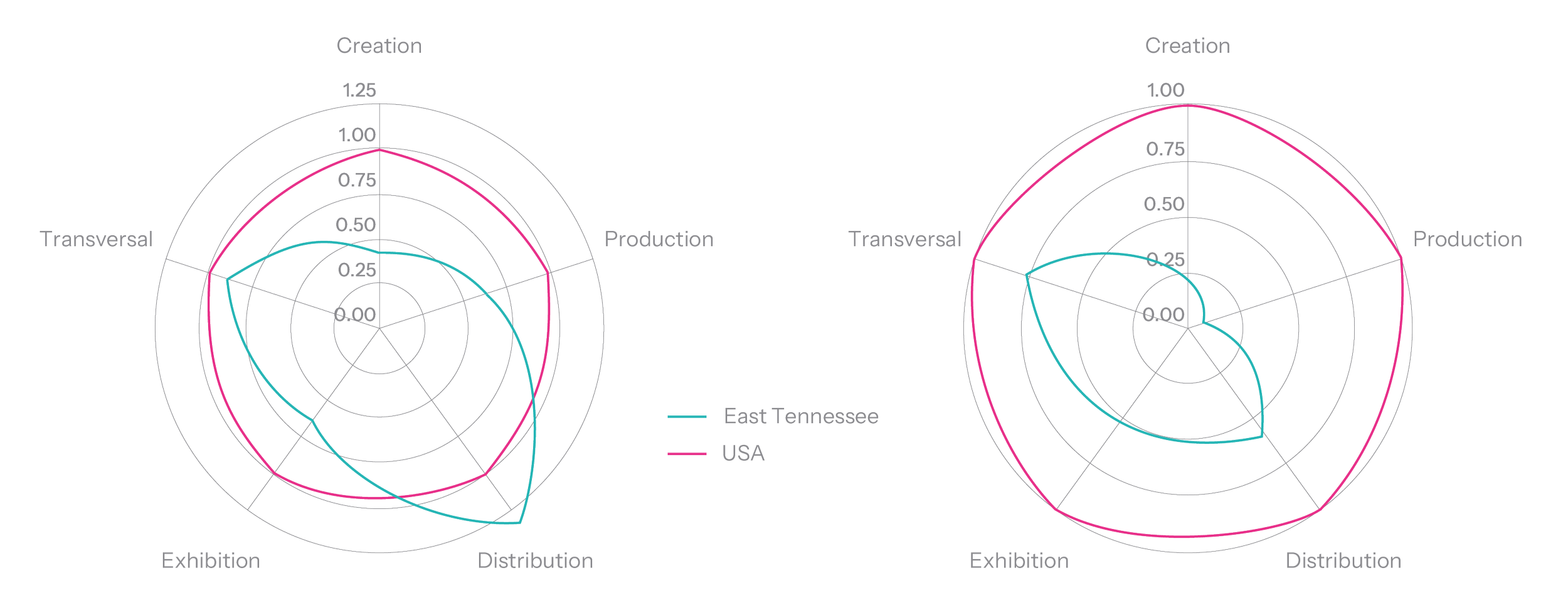
However, the region’s music ecosystem remains below national concentration levels in both establishments and employment, indicating considerable space for growth.

Figure 2. Location Quotients East Tennessee
Source: Quarterly Census of Employment and Wages

Distribution is the most concentrated link. While transversal activities are near the national average, they are slightly underrepresented. Creation and production show the most significant gaps, indicating structural weakness and clear investment opportunities.

There is a need for structured government support to fill those gaps and increase the music sector’s economic impact in the region.

Developed by Sound Diplomacy

East Tennessee Music Ecosystem Total Economic Impact, 2023

Source: County Business Patterns 2023, IMPLAN, Sound Diplomacy Research


Direct Employment


Multiplier effect


1.94%

For every $1 of output of the
music ecosystem
, there is an additional output
of
$0.94 in the rest of the economy.

Composition of total output ($m)


Composition of total employment


Economic Impact

Geographic Concentration

Knox County serves as the primary hub, with Sevier and Blount counties acting as secondary nodes; rural areas remain underserved.

Infrastructure Gap

A critical shortage of mid-sized professional venues (400‑700 capacity) hinders local artists from scaling their audiences.

Venue Landscape

The majority of live music occurs in non‑dedicated spaces (bars and restaurants), limiting the professionalization of the circuit.

Intermediary Scarcity

Support assets like management, booking agencies, and labels are nearly non-existent, forcing a heavy reliance on artist self-management.